


Governments make substantial investments in Vocational Education and Training (VET) to support workforce supply, improve economic outcomes and respond to broader social and industry priorities. One factor in funding decisions is quantification of personal and public benefits from training. For example, analyses often examine the average income levels of people for different levels of qualifications. The marginal impacts of individual qualifications on income have typically been less clear. The development of Jobs and Skills Australia (JSA)’s VET National Data Asset (VNDA) presents an opportunity to strengthen this approach.
Linking training data with employment, income, and demographic data, the VNDA allows governments and providers to examine graduate outcomes at a level of detail that has not previously been available through public or survey data. When combined with information on subsidy rates, qualification completions, and workforce priorities, these data can support a more differentiated view of VET investment.
The analysis below explores some of the insights that could be supported by this type of linked data. It is evidently not a complete assessment of benefits from training, or even how public financial benefit is typically considered. However, it shows how linked outcomes data can help to identify questions that warrant closer examination in funding reviews, workforce planning and business-case development.
In demonstrating this use case, the analysis below combines outcomes information from VNDA with Victorian subsidy rates and completions data from the NCVER.
Some aspects to note are that changes in income and employment are national estimates. In theory, state-level estimates could also be made applying the same approach employed by JSA. These measures are combined to provide a relative sense of where there are greater financial benefits to training. Initial public financial benefits could be subsequently estimated based on assumptions on taxation revenue and spending.
As courses are subsidised by hour in Victoria, indicative course-level subsidies are based on maximum nominated hours.
Non-apprenticeship qualifications generally involve lower total subsidies (around $5k on average) and are associated with moderate increases in graduate income ($12.5k increased income per year). Apprenticeships require a substantially larger public investment ($15k) but are also associated with stronger income improvement (~$30k).
Based on income benefit per dollar invested, non-apprenticeship qualifications appear to provide a stronger immediate financial return on average at lower initial outlay than apprenticeships.
However, even among apprenticeships there is a wide variation in financial returns. The data show that apprenticeships subsidised at around $15k range yield changes in income ranging from less than $10k per year to more than $50k per year.
Electrical and agricultural mechanical apprenticeships support some of the highest average increases in income. Conversely, there are several apprenticeships where such returns are not as apparent.
Apprenticeships do serve other functions, such as workforce development and entry pathways, but awareness of the diversity of financial outcomes based on real data at qualification level can help to nuance how each training product is best supported or delivered.
Figure 1 Apprenticeships produce stronger income gains but require more substantial investment
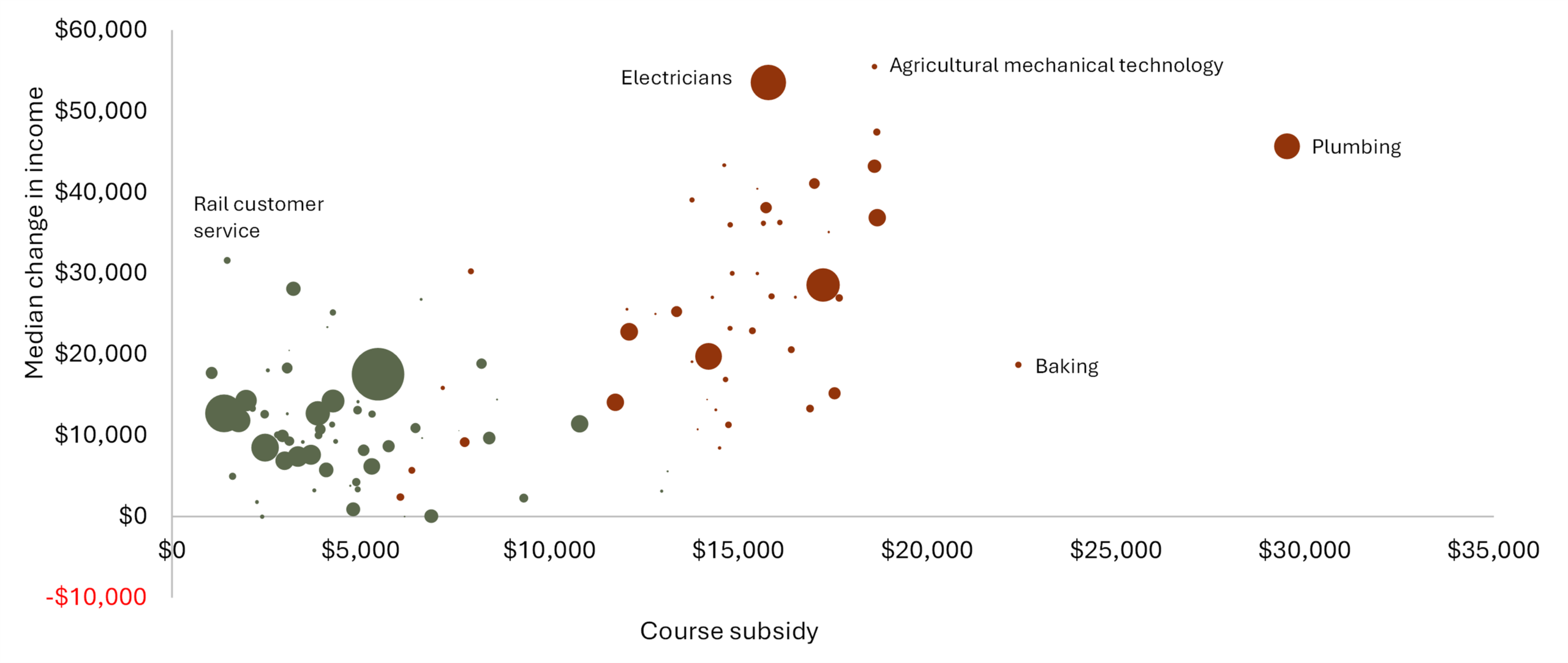 Note: Bubble size corresponds to the number of course completions. Red bubbles are courses that can be delivered as apprenticeships based on the Victorian Government’s Training Needs. Source: Bower Insights Analysis based on VNDA, VOCSTATS, and Victorian Training Needs List data. |
At diploma level, several care-economy qualifications are associated some of the most significant increases in graduate income. Nursing, community services, emergency health care, youth work and dental technology each show increases of approximately $20,000 in median employment income.
The relationship between subsidy and income benefit is not uniform. Nursing attracts a relatively high subsidy and is delivered at substantial scale. Community services and emergency health care appear to generate similar income increases at a lower estimated subsidy.
Again, these comparisons should not necessarily be interpreted as a basis for redirecting funding solely toward lower-cost courses. They instead could help to identify where there may be benefit in testing alignment between funding settings, student contributions, and workforce outcomes.
Remedial massage illustrates the importance of using multiple measures, even to understand overall financial benefit. The VNDA data shows a small decline in median employment-based income following completion. However, a significant proportion of graduates exit income support programs following training, suggesting positive overall public financial benefit may be being achieved.
Figure 2 Diploma level qualifications provide strong outcomes across parts of the care economy
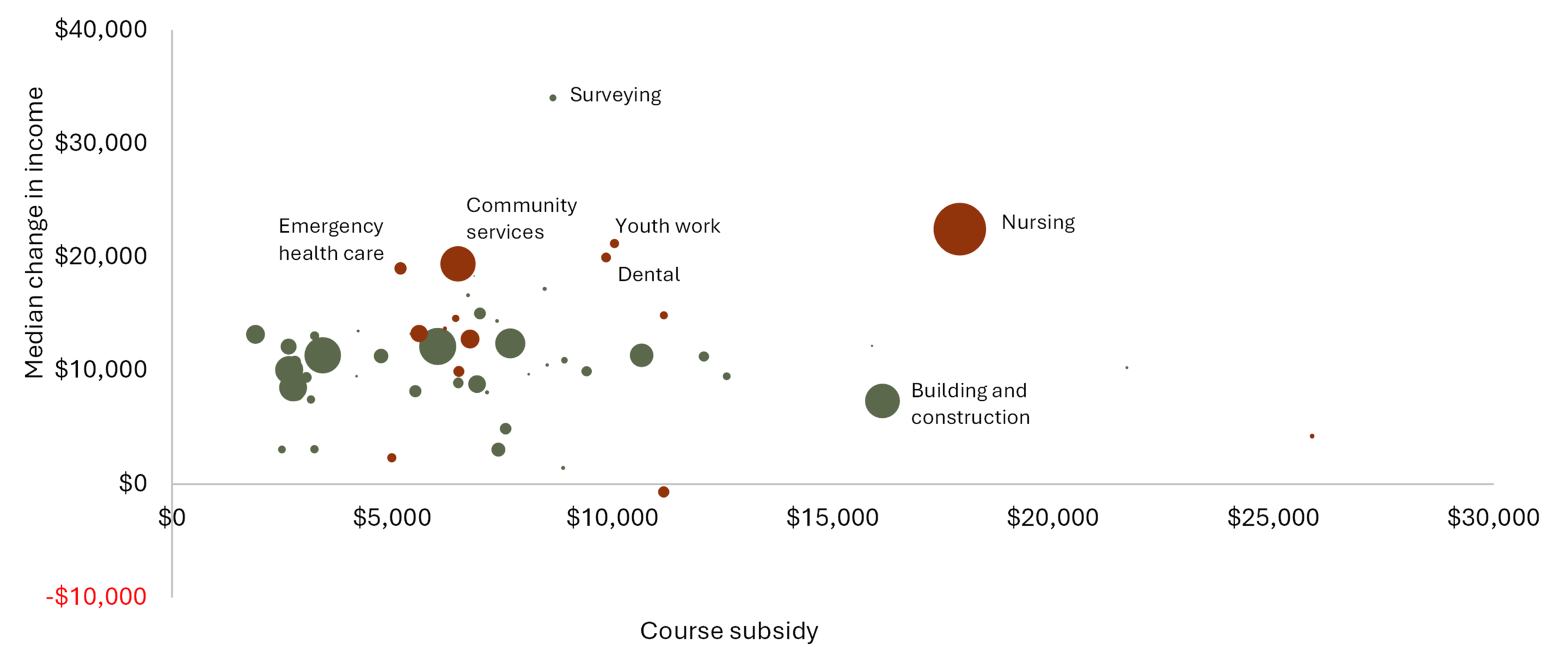 Note: Bubble size corresponds to the number of course completions. Red bubbles are courses that are identified as related to the care economy based on the Victorian Government’s Training Needs. Source: Bower Insights Analysis based on VNDA, VOCSTATS, and Victorian Training Needs List data. |
All good investment frameworks begin with the question of what outcome is being purchased. While the analysis here examines part of a single financial dimension, it is only a component of how robust decisions can and should be made.
The information in the VNDA does appear to support the ability to ask better investment questions, such as:
For governments, evidence of outcomes based on linked data provide an opportunity to strengthen subsidy reviews, workforce planning and program evaluation. This can help make the rationale for different investments explicit, and to assess whether each qualification is achieving the outcome for which it is funded.
For training providers, the data can support decisions about course portfolios, industry partnerships and investment in new delivery capability. It can also strengthen business cases by demonstrating how proposed training responds to workforce demand and produces measurable outcomes.
The next step is to integrate graduate outcomes data into a broader VET investment framework that combines financial, labour market, and social value measures. This would allow funding bodies to move beyond activity based measures and make more transparent decisions about where additional investment, redesign or closer evaluation is required.



