


Governments are usually willing to accept the recommendations of Royal Commissions. Doing so is often a commitment to address longstanding problems with how a system operates.
But accepting a recommendation, and even acquitting it as completed, is not the same as delivering a Royal Commission’s intent.
Royal Commissions are typically established because existing systems and policy arrangements have failed. Their recommendations are intended to address these failures, often by changing the structures and incentives that contributed to them.
The decisions made during implementation are therefore critical. Victoria’s Mental Health and Wellbeing Levy provides a useful example of how the intent of a recommendation can be diluted, or even lost, as it is implemented.
In its 2019 Interim Report, the Royal Commission into Victoria’s Mental Health System recommended a new revenue mechanism for operational funding, alongside a dedicated capital investment fund.
The Commission identified that mental health had historically struggled to secure adequate and sustained investment through conventional budget processes.
One reason outlined for this is that developing business cases for mental health investment is challenging when outcomes are not always easily measured or demonstrated.
The Commission also anticipated that the political attention given to mental health reform would eventually subside. Without changes to funding arrangements, mental health would continue competing for resources through the same processes that had contributed to underinvestment.
The solution proposed was a new revenue mechanism (the levy). The Royal Commission outlined how it intended the levy would address these problems (emphasis in bold is our own)[1]:
Rather than simply raise more revenue, the intent of this recommendation was to change how mental health investment was both secured and directed. That is, the new revenue mechanism was intended to be for additional revenue that could be directed intentionally and strategically to address the other issues the Royal Commission had identified.
Since the levy commenced in January 2022, Victoria has substantially increased mental health expenditure. Mental health output funding has grown from approximately $1.66 billion in 2018–19 to a budgeted $3.25 billion in 2026–27, an increase of almost 96 per cent. This investment has supported additional services, infrastructure and workforce capacity.
However, the increase in total expenditure does not tell us how much of this investment is attributable to the levy.
Mental health funding was already increasing before the Royal Commission. Although difficult to track due to changes in departmental portfolios, we estimate that in the five years to 2018–19, expenditure grew by approximately 7.1 per cent annually, broadly consistent with other health services.
Some funding growth would therefore have been expected regardless of the levy, reflecting increasing wages, demand and the costs of maintaining services. This is what the Royal Commission meant by the current level and expected growth in existing funding that the levy was to supplement.
The relevant question is how much expenditure has increased beyond what would otherwise have occurred.
To assess this, we need a counterfactual: an estimate of how mental health funding would have grown without the levy.
Using historical mental health funding growth, or indexing the funding to growth in other health outputs, suggests that mental health output funding would have reached approximately $2.7–$2.9 billion in 2026–27. This compares with budgeted expenditure of $3.25 billion.
A counterfactual can be extended across the years since the levy has been introduced, as shown below. This analysis examines what would have happened if mental health funding had grown in line with other health output funding from 2019. Against this counterfactual the analysis estimates that only around 30 per cent of levy appropriations to 2026–27 correspond to expenditure above that estimated baseline.
The remaining 70 per cent, approximately $4.7 billion cumulatively, corresponds to funding growth that may have occurred anyway.
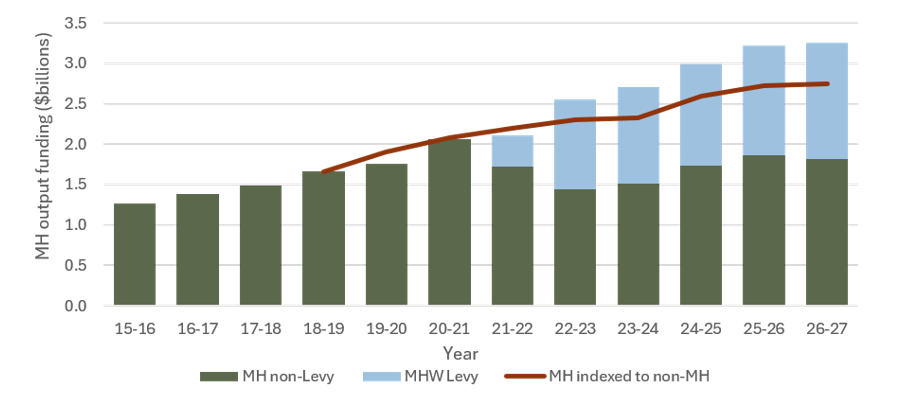
Source: Bower Insights, based on Victorian Government budget papers and Annual Financial Reports. Notes: 2026-27 figures are budgeted, 25-26 are expected, and previous years are actual figures. MH funding includes both clinical and community care budget outputs. Indexation of 2019 MH funding is based on other current health outputs, excluding public health. The underlying analysis file can be provided on request at info@bowerinsights.au
These estimates depend on assumptions about how funding would have grown without the levy. They do not establish what government would have spent, nor suggest that levy revenue has been used outside mental health.
But they do raise a significant question about whether the levy has achieved the Royal Commission’s objective of providing additional investment, and not replacing funding growth that would otherwise have been provided.
The explanation for the level of apparent substitution in funding lies partly in the legislation and financial arrangements established for the levy.
Part 17.4 of the Mental Health and Wellbeing Act 2022 provides for levy revenue to be appropriated towards mental health and wellbeing outputs.
However, the legislation does not require expenditure to exceed an indexed baseline of existing funding or otherwise demonstrate that levy revenue is additional to what government would have spent.
Nor does it require individual levy-funded activities to be separately identified and tracked. There is no requirement for the levy to specifically fund Royal Commission recommendations or provide strategic investments that improve the efficiency of investment in mental health (such as through earlier intervention).
Instead, compliance can be demonstrated by showing that total expenditure on eligible mental health outputs exceeds the amount appropriated from the levy.In practical terms, mental health expenditure could be substantially reduced and still satisfy this requirement.
Further, any additionality to baseline funding provided by the levy is a choice of government rather than a requirement of the levy’s use.
There are three relatively straightforward changes that could bring the levy closer to the Royal Commission’s original aims.
First, establish a funding baseline. Levy expenditure should be assessed against an indexed level of baseline mental health funding, accounting for the expected growth in the cost of maintaining services. Only expenditure above this baseline should count towards the acquittal of revenue collected by the levy.
Second, allow funding to accumulate. Major reforms do not necessarily require expenditure to increase evenly each year. A dedicated Mental Health and Wellbeing Fund could retain revenue across financial years, allowing investment to be aligned with reform priorities rather than annual revenue collections. It would also ensure funding remains available independently of annual budget decisions, while maintaining appropriate scrutiny and oversight of individual investments, as outlined below.
Third, strengthen accountability. Reporting should identify how levy revenue has been allocated, what additional expenditure it has supported and what outcomes are being achieved. This would help provide reassurance to business (that pays the levy) that their contribution is addressing the issues the Royal Commission raised. It would also provide greater transparency on the impact of the levy. Independent scrutiny would help establish whether the funding mechanism continues to meet its purpose and is at the scale that is required.
These changes would not remove the need for government to make responsible decisions or demonstrate value for money. Nor would the introduction of a baseline necessarily require a full restoration of what would have been funded by this time.
However, the proposed approach would help to address the issues the Royal Commission identified, require additionality, and enable clear and transparent strategic investment that reduces the long-run cost of mental health service delivery while improving mental health outcomes for Victorians. By improving transparency around the use of the levy the changes would also provide businesses with more confidence that their contribution to improving the mental health system is achieving outcomes.
Victoria’s mental health levy has raised substantial revenue and accompanied significant growth in mental health expenditure. But the Royal Commission was seeking more than a new revenue source. It wanted to address a structural problem in how mental health investment was secured and directed.
The levy illustrates how a recommendation can be formally implemented while leaving important aspects of the underlying problem unresolved.
And this is relevant well beyond mental health. Governments commonly measure progress on reform through recommendations accepted, legislation passed, programs established and funding allocated. These are important milestones, but they tell us relatively little about whether the changes have been delivered in a way that achieves the intended outcomes.
The broader lesson is that implementation should be judged against the problem a recommendation was intended to address, rather than whether the prescribed actions have been completed. Where reform seeks systemic change, this requires maintaining a clear connection between policy intent, implementation arrangements, and measurable outcomes.
[1] Royal Commission on Victoria’s Mental Health System Interim Report, November 2019, page 480



